Cladistic Analysis is a tool used by paleontologists and biologists to understand the tree of life. It is based on a straightforward principal. If you are considering more than one possible family tree, the one that accounts for the most observed characters with the fewest evolutionary steps is probably the accurate one. Lots of characters of lots of species are fed into a computer, which constructs and compares trees looking for the simplest possible version.
I have nothing against cladistics, per se. What I object to is the view that a cladogram is not just an attempt to understand life’s interrelationships, but rather that it is an objective definition of those relationships that can only be modified or overturned by another cladogram with a larger data matrix.
The computer only does the math, after all. Fallible humans must figure out which characters and species to include and how to reduce those characters to the 1s and 0s that the computer can crunch. The computer makes no decision about the relative likelihood of convergence or the genetic complexity of a particular feature. The subtle curve of a femur caries the same weight as a fully formed, asymmetrical flight feather. To the computer, 1s are 1s and 0s are 0s.
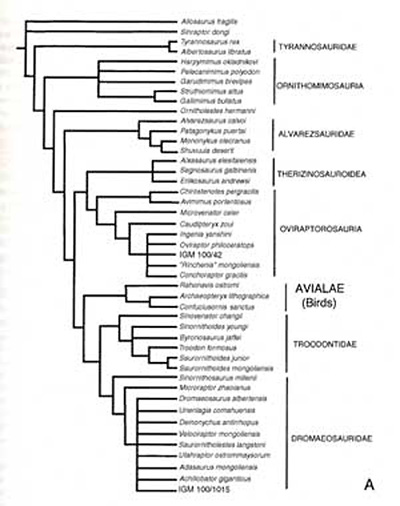
And nature doesn't ALWAYS move in straightlines.There are clearer renditions of this same cladogram towards the end of my essay, “Feathers: What’s flight got to do …. got to do with it?”